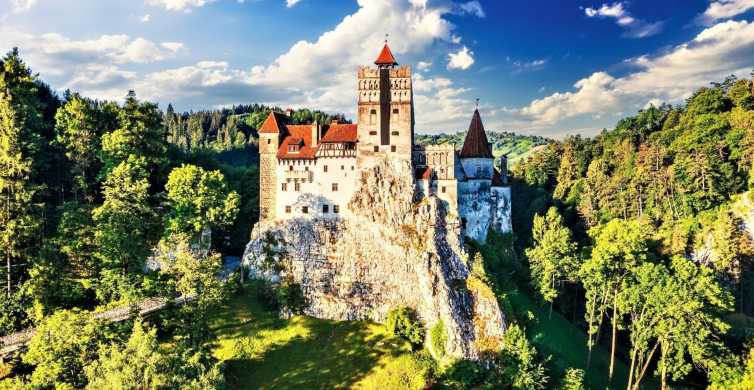
Located dramatically on the border between Transylvania and Wallachia, Bran Castle is arguably Romania’s most recognizable landmark — and one of Europe’s most compelling medieval fortresses. Millions of visitors travel here each year drawn by whispers of vampire legends, gothic atmosphere, and centuries of turbulent history. But the true story of Bran Castle is far richer, more complex, and ultimately more fascinating than any myth.
The Origins of Bran Castle: Built to Guard a Kingdom
The story of Bran Castle begins in 1377, when King Louis I of Hungary granted the citizens of Brașov an extraordinary privilege — the right to construct a stone fortress at the gateway of the Bran Pass. This narrow mountain corridor cutting through the Carpathians was one of the most strategically vital routes connecting the medieval provinces of Transylvania and Wallachia, making whoever controlled it enormously powerful.
The original fortification was likely preceded by a wooden structure, but the stone castle that rose from the rocky outcrop quickly became an imposing and permanent fixture of the landscape. Built using local labor and materials, its construction reflected the urgent need to protect the region from increasingly aggressive military threats advancing from the south and east.
A Fortress That Shaped Regional History
For centuries, Bran Castle served a dual purpose that made it indispensable to the region’s survival and prosperity:
- Military Defense: The castle formed a critical line of resistance against Ottoman incursions into Transylvania. Its elevated position offered commanding views of the surrounding valleys, allowing defenders to spot approaching forces long before they reached the pass.
- Commercial Control: Bran Castle also functioned as an official customs checkpoint, where merchants traveling between Transylvania and Wallachia were required to stop, declare their goods, and pay applicable duties. This gave the fortress not only military importance but also significant economic leverage over regional trade.
The combination of these roles meant that Bran Castle was never simply a noble residence — it was a living, working instrument of power and governance that shaped the political and economic landscape of medieval Romania.
Vlad the Impaler and the Dracula Connection: What History Actually Tells Us
No discussion of Bran Castle is complete without addressing the legend that defines it in the popular imagination — its supposed connection to Vlad III, Prince of Wallachia, better known as Vlad the Impaler or, chillingly, Vlad Dracul’s son: Vlad Dracula.
Vlad ruled Wallachia during the mid-15th century and earned a fearsome reputation across Europe for his brutal methods of punishing enemies and enforcing order — most infamously, mass impalement. His name and deeds were so notorious that stories about him circulated widely even during his lifetime.
However, the historical evidence linking Vlad to Bran Castle is remarkably thin. While it is plausible — even likely — that Vlad passed through the Bran Pass during military campaigns or diplomatic missions, no credible historical documentation places him as a resident or long-term occupant of the castle itself. The most direct historical connection is somewhat ironic: records suggest that Vlad may have been briefly held prisoner at or near Bran during a period of political conflict, hardly the romantic association the legend implies.
The iconic image of Bran Castle as Dracula’s Castle is primarily a product of Bram Stoker’s 1897 gothic novel Dracula, in which the author imagined a dark, imposing Transylvanian fortress as the home of his vampire count. Stoker never visited Romania, and Bran Castle is not explicitly named in the novel. Yet the castle’s unmistakable silhouette — turrets rising dramatically from a rocky cliff, surrounded by dense Carpathian forest — so perfectly matched the gothic imagery Stoker described that the association became, over time, irresistible and essentially permanent.
The result is a fascinating cultural phenomenon: a real medieval fortress whose global fame rests largely on a fictional story, yet whose actual history is independently extraordinary.
Queen Marie and the Royal Chapter: A Castle Reborn
One of the most overlooked and genuinely captivating chapters in Bran Castle’s history began in the early 20th century, when Queen Marie of Romania fell in love with the property and transformed it into a beloved royal retreat.
Following World War I, the castle was gifted to Queen Marie by the citizens of Brașov in 1920 as a gesture of gratitude and goodwill. Marie, known for her vibrant personality, deep love of Romania, and considerable artistic sensibility, immediately set about renovating and personalizing the fortress. She introduced electricity, modernized the interiors, and decorated the rooms with an eclectic mix of Romanian folk art, Byzantine influences, and Western European furnishings — creating a home that was both regal and warmly personal.
Queen Marie spent many happy years at Bran, and her connection to the castle was profound. Upon her death in 1938, she reportedly requested that her heart be preserved and kept at the castle she loved so dearly. The estate then passed to her daughter, Princess Ileana of Romania, who continued to maintain it as a family home.
Confiscation, Communism, and a New Life as a Museum
The peaceful royal era at Bran came to an abrupt end in 1948, when the newly established communist regime in Romania confiscated the castle from Princess Ileana without compensation — part of the regime’s sweeping nationalization of private property across the country. Ileana was forced into exile, eventually settling in the United States, where she later became an Orthodox Christian nun.
By 1956, the communist government had converted Bran Castle into a public history museum, opening its doors to Romanian visitors and international tourists alike. While the political context of its opening was fraught, the decision to preserve the castle as a museum undoubtedly protected it from neglect or demolition.
After the fall of communism, a lengthy legal process culminated in 2006 when the Romanian government formally returned the castle to the heirs of Princess Ileana, led by her son Dominic von Habsburg. Today, the castle continues to operate as a museum under private ownership, welcoming hundreds of thousands of visitors annually.
Exploring Bran Castle Today: What to Expect
A visit to Bran Castle is a genuinely multi-layered experience that rewards curiosity and imagination in equal measure. Here is what awaits you:
- Medieval Architecture: Wander through a labyrinth of narrow stone staircases, hidden passages, and compact chambers that reveal how a working medieval fortress was organized and defended.
- Royal Apartments: Explore the beautifully preserved rooms once occupied by Queen Marie, complete with original furnishings, personal artifacts, and decorative details that reflect her remarkable character.
- Historical Exhibitions: Thoughtfully curated displays present the castle’s documented history alongside honest, engaging explanations of the Dracula legend — separating fact from fiction while honoring both.
- Panoramic Views: The castle’s hilltop position offers breathtaking views across the Carpathian Mountains and the surrounding valleys — scenery that alone justifies the visit.
- The Outdoor Museum: The grounds feature a charming open-air village museum with traditional Transylvanian buildings, providing valuable context about the broader regional culture and heritage.
A Place Where History and Legend Intertwine
What makes Bran Castle truly unique is precisely this layering of realities. It is simultaneously a genuine medieval fortress with a documented history spanning nearly 650 years, a royal home filled with personal memories and artistic vision, and a cultural symbol whose global identity has been shaped as much by literature and imagination as by stone and mortar.
Whether you arrive as a history enthusiast, a Dracula devotee, a lover of architecture, or simply a traveler seeking one of Eastern Europe’s most atmospheric destinations, Bran Castle will not disappoint. It is a place that invites you to look beyond the legend — and discover that the truth is just as extraordinary.
Plan your visit to Bran Castle and step inside one of Romania’s most storied landmarks — where centuries of authentic history and timeless legend come alive within the walls of an unforgettable fortress.